UNFC and UNRMS: Self-assessment and practical exercises

Course Start
Nov 12, 2026
Course End
Nov 30, 2030

Duration
02:00

Certificate
Yes
About This Course
The transition to a low-carbon economy is reshaping global demand for energy and raw materials. Meeting the goals of the Paris Agreement will require large and growing quantities of critical energy transition minerals, together with more efficient use, recovery and recycling of the resources already in circulation. Governments, industry, investors and civil society need consistent and transparent information about these resources to make sound decisions. The United Nations Framework Classification for Resources (UNFC) and the United Nations Resource Management System (UNRMS), developed under the United Nations Economic Commission for Europe (UNECE), provide internationally applicable tools for this purpose.
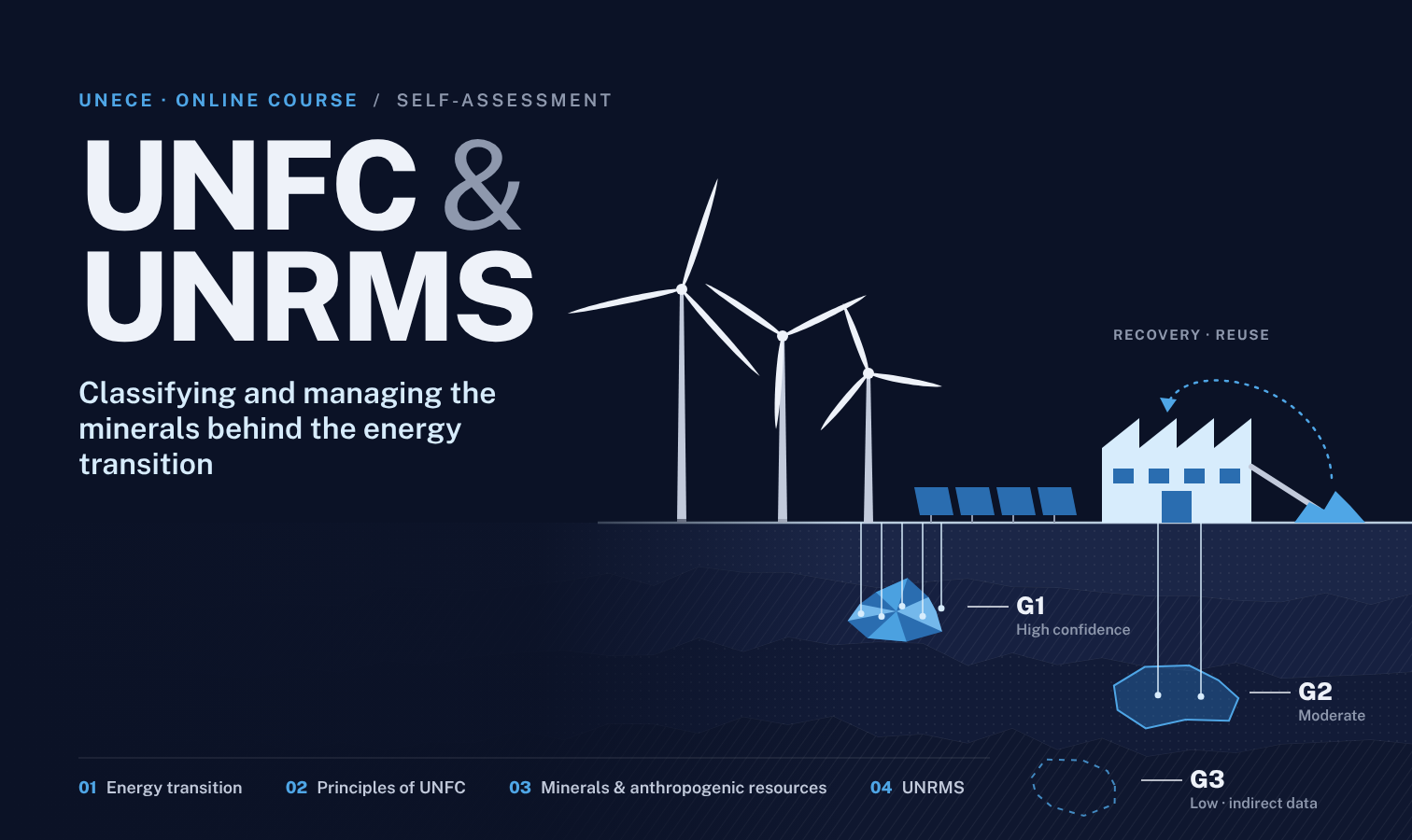
This online course introduces the principles of UNFC and UNRMS and gives participants the opportunity to apply them. UNFC classifies projects according to three criteria: environmental-socio-economic viability (E axis), technical feasibility (F axis) and the degree of confidence in the estimated quantities (G axis). UNRMS builds on this foundation with a set of principles for the integrated and sustainable management of resources across their full life cycle.
The course is organized into four modules, each combining a video lecture with an interactive knowledge check:
- Module 1: The Energy Transition and Critical Energy Transition Minerals
- Module 2: Introduction to the Principles of UNFC
- Module 3: UNFC for Minerals and Anthropogenic Resources
- Module 4: Introduction to UNRMS
In the applied exercises, participants assess a case study project for a regional raw materials recovery and waste treatment facility and classify it on each UNFC axis, reflecting the kind of evaluation carried out in real resource projects.
What you will learn
After completing the course, participants will be able to:
- Explain the resource challenge of the energy transition: Describe the role of critical energy transition minerals, the guiding principles recommended by the UN Secretary-General's Panel on Critical Energy Transition Minerals, and why recycling must be combined with responsible primary extraction and governance.
- Understand the principles of UNFC: Explain how UNFC defines a project and how it is used by governments, industry and financial institutions.
- Apply the UNFC E, F and G axes: Evaluate project information on environmental-socio-economic viability, technical feasibility and confidence in estimates, and assign the appropriate UNFC categories.
- Classify minerals and anthropogenic resources: Apply UNFC to projects that recover materials from waste and secondary sources in support of a circular economy.
- Describe UNRMS and its principles: Explain the purpose of UNRMS and principles such as Comprehensive Resource Recovery and Value Addition across the resource life cycle.
Target Audience
This course is designed for government officials and policymakers responsible for natural resources, energy and environment; professionals in the mining, energy, waste management and recycling sectors; investors and financial institutions assessing resource projects; and researchers, students and civil society representatives interested in the sustainable management of resources.
Requirements
There are no formal prerequisites for this course. A general familiarity with natural resources, energy or environmental management is helpful but not required.
This course has been jointly developed by
UNU-INWEH
United Nations University Institute for Water, Environment and Health specializing in water-related research and capacity development
UNECE
The United Nations Economic Commission for Europe, which develops and maintains the United Nations Framework Classification for Resources (UNFC) and the United Nations Resource Management System (UNRMS)